The Golden Ass
Las Ramblas, Barcelona, Spain, 2008
Background
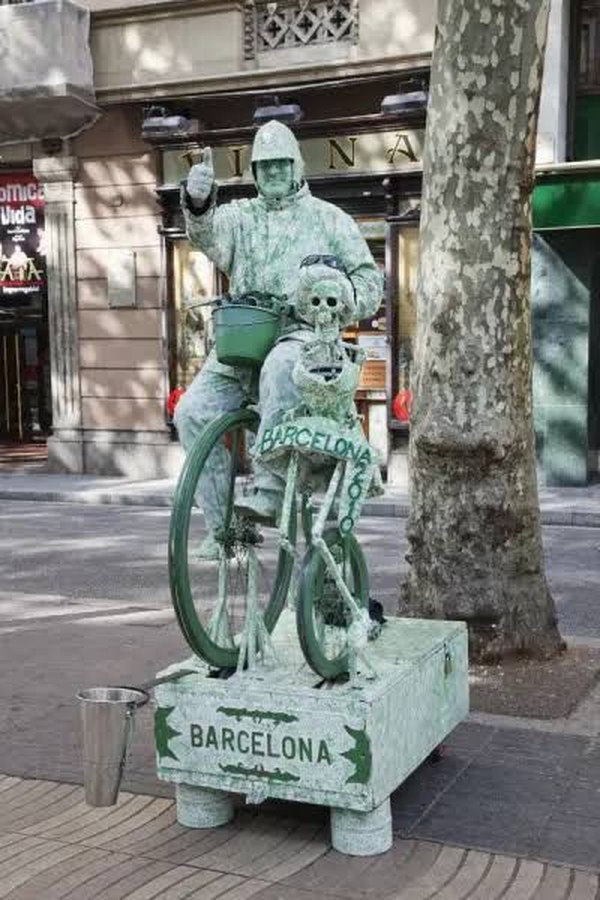
In the summer of 2008 an arts organization invited me to do the Embed Series in Barcelona. After scouting the city I decided to make a sculpture disguised as a living statue on Las Ramblas. Living statues come out of the tableau vivant. In medieval and Renaissance pageantry a group of people held a scene on a decorated stand along the route of a royal entry. The version on Las Ramblas is contemporary busking. Performers work in costume, often painted gold or silver. They stand still until a coin goes into a donation bucket, then they move so a visitor can take a photograph. The city licenses the work. Applicants go before a municipal jury and are assigned marked ground.
For the Embed Series, nesting a sculpture inside that act was the injection point. The pose was a figure on hands and knees with a rubber donkey mask. I titled it The Golden Ass afterward, after the book by Apuleius: a man named Lucius, obsessed with magic, is accidentally turned into a donkey and endures dehumanization. Living-statue performers often face poor treatment and severe physical strain. Because they look like objects, some passersby poke, prod, or touch them without consent to see if they are real. On rarer occasions they are assaulted, kicked, or have their tip buckets stolen.
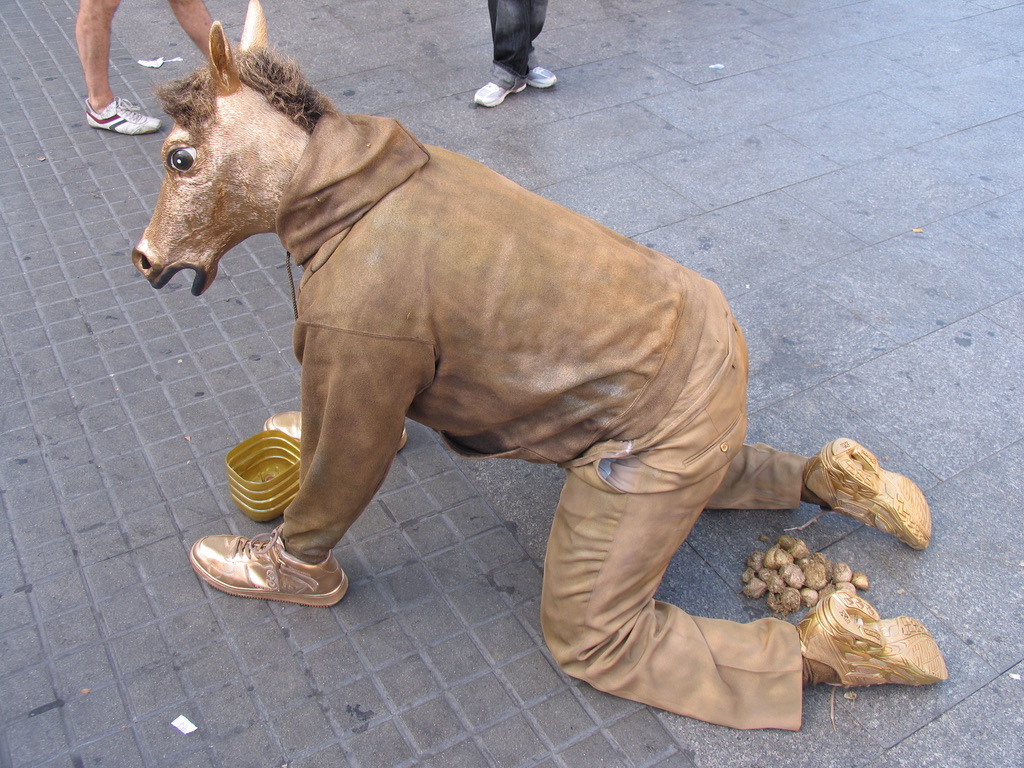
Installation
It went in on Plaça de Catalunya, near the head of La Rambla, where the living statues work under permit. I added gold spray-painted horse shit and a tip bucket. The café terrace near the figure was the observation point. I sat there with an assistant who held a permit for the artwork.
Reaction
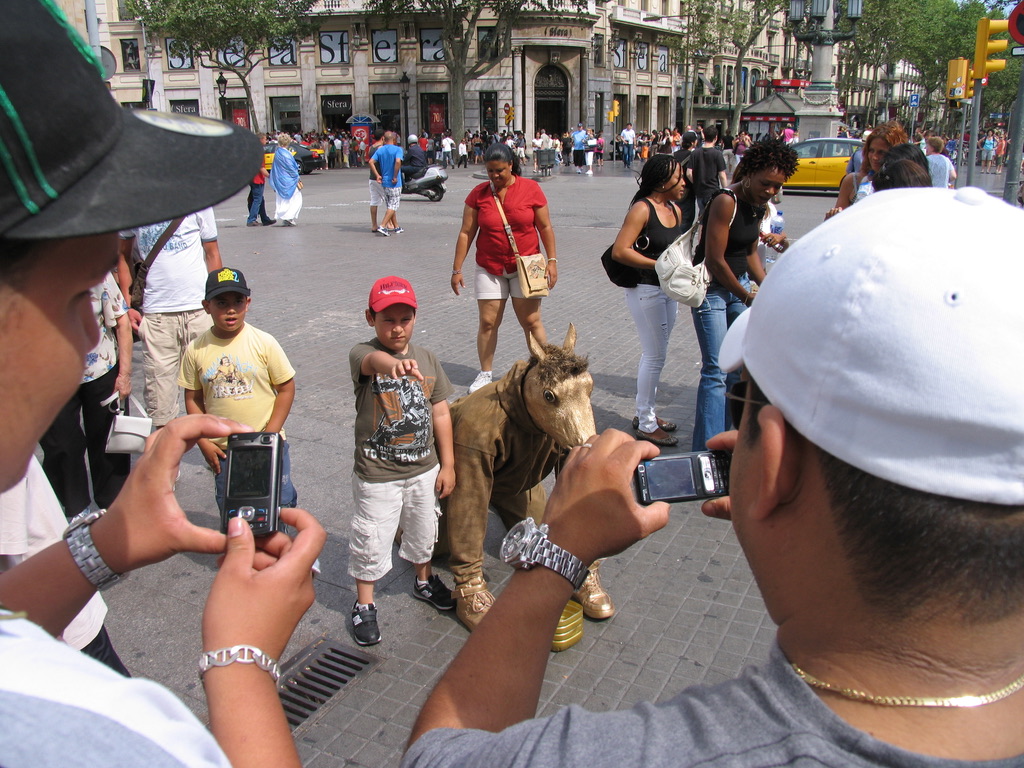
People took the figure for a living statue. Those performers stay motionless, so the sculpture fitted that reading. The pose on hands and knees would have been hard for a person to hold. That did not stop the first reading.
Watch the installation on YouTube
The break came when someone put a coin in the bucket. A living statue usually moves after a coin. This one did not. People treated that as a rip-off and tried to provoke it.
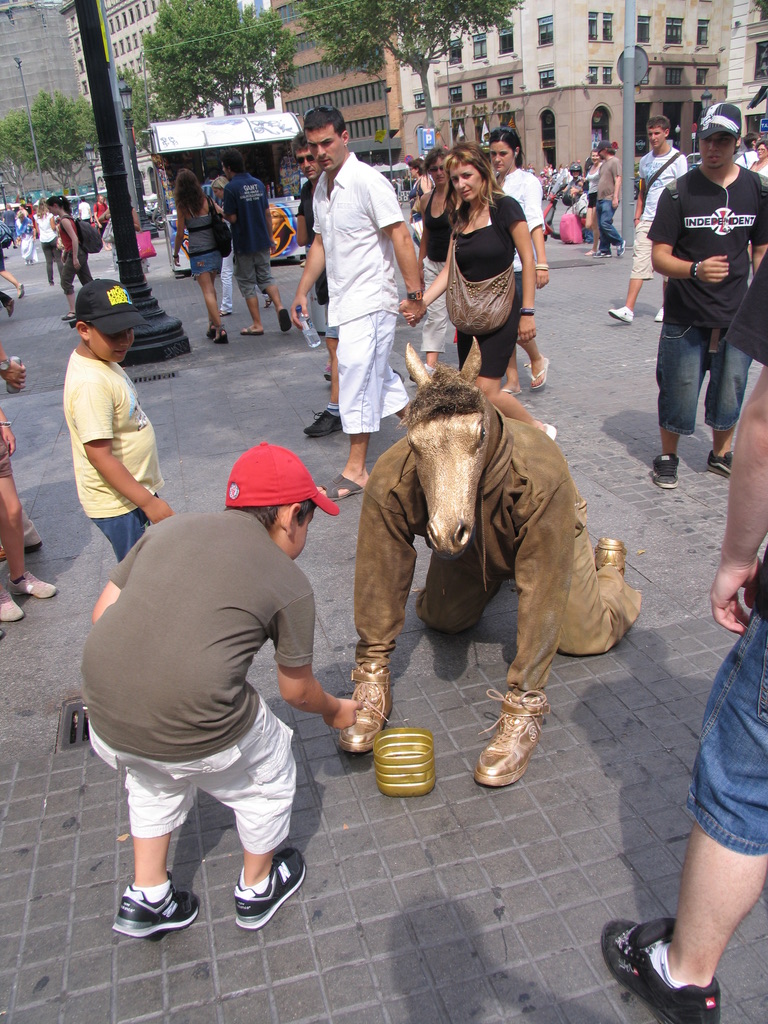
The handling matched what living-statue performers already get: harassment, prodding, touching, poking. Once someone touched it, the realism collapsed. They saw it as a gag. The cluster broke up. About fifteen minutes later a similar cycle started again.
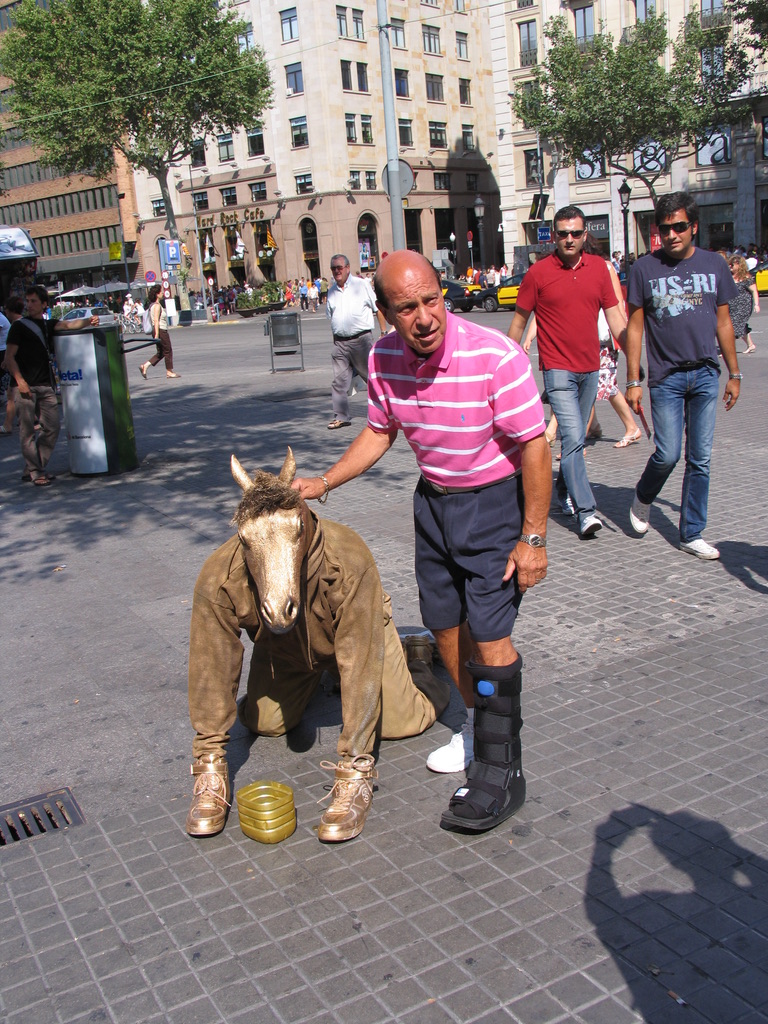
Money piled up in the bucket. The assistant emptied it when it reached a certain level, because people had begun to eye the money. We took the coins rather than lose the bucket. The sculpture earned roughly four hundred euros that day. When it still did not move after the bucket had overflowed, people grew paranoid of it. It had begun to evoke fear.
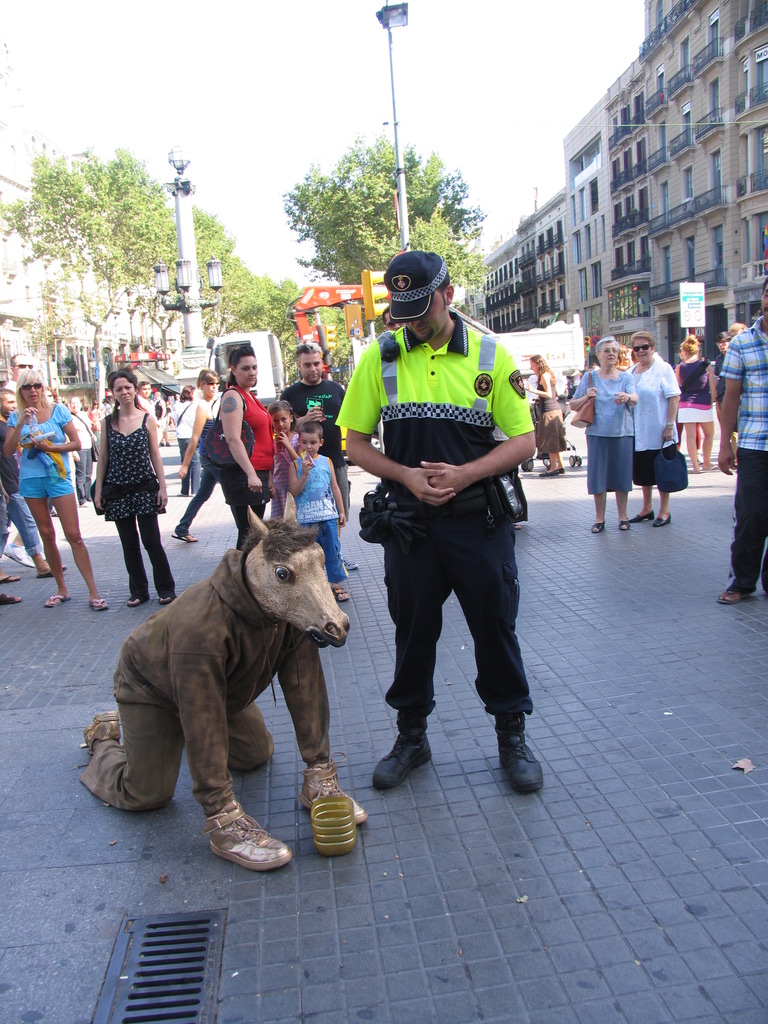
Police arrived at one point and tried to speak to the statue, on the assumption that it was working without a permit. The assistant came forward and showed that it was a sculpture with a permit to be there.
A living-statue performer came up to complain. The charge was that the piece was leeching off their economy and that it should be required to hold a permit the way they do. The assistant asked if I wanted to say anything to him. I said that if a person was allowed to pretend to be a sculpture, then it was fair game for a sculpture to pretend to be a person. He did not appreciate that.
Lens
Under the lens, the most interesting thing was the way the blood cells clustered around the anomaly and then dissipated. Living statues are supposed to move when given a coin. The fact that this one did not was a weather bell that something was off. A living statue is generally disregarded as a tourist prop. This one forced the cells to question what normal behavior for a living statue even is.
The police arriving showed that the injection had worked. They thought the virus was real and out of order for not having a permit.
The blood cell performing on the street criticized the virus for exploiting them financially. That was an economic phenomenon. The performers are there because it is a tourist destination. They are not the destination.
Conclusion
The installation was a clean way to inject the virus into the vein. It was also a chance to see the vein as a place for artwork beyond graffiti and sanctioned public art. Street performers already occupy that space. They are a fixture in tourist areas.
Watching the virus earn four hundred euros in a day was unique among the other installations. It also showed how easily a virus can inhabit public space. Most of the cells that passed locked the encounter in as a real person, and as a real place in memory.
The Golden Ass, in the end, became a metaphor for the performers themselves.
Glossary
Tableau vivant. A held live scene. In medieval and Renaissance pageantry a group stood still on a decorated stand along the route of a royal entry. The living statue on Las Ramblas is the reduced, commercial descendant of that form.
Living statue. Contemporary busking that uses stillness as the act. The performer works in costume, often painted gold or silver, remains motionless until a coin goes into a bucket, then moves so a visitor can take a photograph. In Barcelona the city licenses the work. Applicants go before a municipal jury and are assigned marked ground.
Custom. The unwritten contract of that act: coin buys motion. When the sculpture takes the coin and does not move, the custom breaks. Anger is the first reading of that break. Fear is a later one.
First reading. What the cells take the object to be before they test it. On Las Ramblas the first reading was a living statue. Most cells never left that reading.
Cluster. A temporary gathering of cells around the anomaly. On this piece a cluster formed, broke when the figure was touched or refused to move, and formed again about fifteen minutes later with a new set of cells.
Marked ground. The licensed patch of pavement assigned to a living statue after the municipal jury. The sculpture was placed in that working zone, not beside it.
Embed Series. Cast figures dressed and placed so they read as people already using the street. The Golden Ass is an Embed nested inside an existing street act rather than invented as a new one.
Injection / injection point. The exact occupation chosen for the virus. Here the injection point was the living-statue act itself: pose, gold, bucket, licensed ground.
Virus. A camouflaged human figure placed in the vein so that other cells treat it as one of their own until a test breaks the reading.
Vein. The street as circulation. Las Ramblas is a tourist vein: high flow, short memory, constant refresh of cells who have not seen the last cluster collapse.
Blood cells / cells. People in that circulation. They are not an audience first. They are traffic that may or may not stop.
Lens. The Human City reading applied after the facts are down. It classifies what happened. It does not replace Background, Installation, or Reaction.
Permit. Official sanction for the object to occupy the vein. On this piece the assistant held a permit for the artwork. Police arrived as if the figure were a worker without one.
Camouflage. The condition in which the figure passes as a person, or as the act it is nested in. Touch ended the camouflage. Most cells never touched it.
Immune response. The city’s defensive layer. Here the immune reading was a statue assumed to be working without a permit.
The longer list is in the glossary.