Sleepers
Winston-Salem, North Carolina, 2009
Background
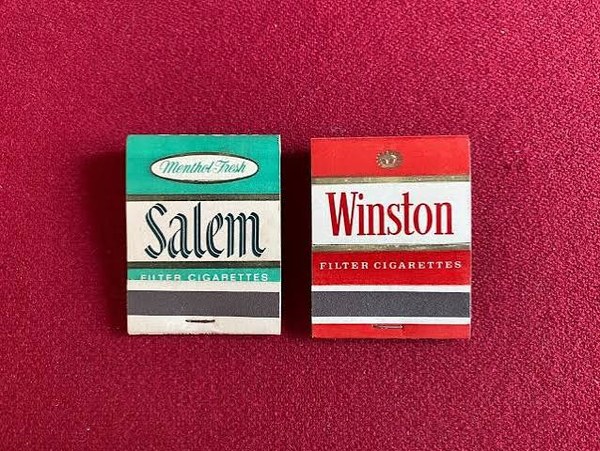
Winston-Salem, North Carolina, is a city named after two towns that merged. Salem was the older Protestant settlement. Winston grew as an industrial town after the Civil War. R.J. Reynolds built the tobacco factories that made it a company town. The packs were named after the city: Winston and Salem. The city still carries the architecture of that fortune: the Reynolds Building, the factories, the Reynolda House estate later turned museum as a cornerstone, the scale of a place built on one product.
SECCA, the Southeastern Center for Contemporary Art, is a contemporary gallery in Winston-Salem with no permanent collection. It shows regional, national, and international work. Founded as a private institution, it became an operating entity of the North Carolina Museum of Art under the Department of Natural and Cultural Resources in 2007.
I was invited by SECCA to put work around the city and accepted. At the time I was a smoker, and upon my arrival one of the staff saw my pack of Camels and thanked me for supporting the home team.
Installation 1: Billboard Sleeper
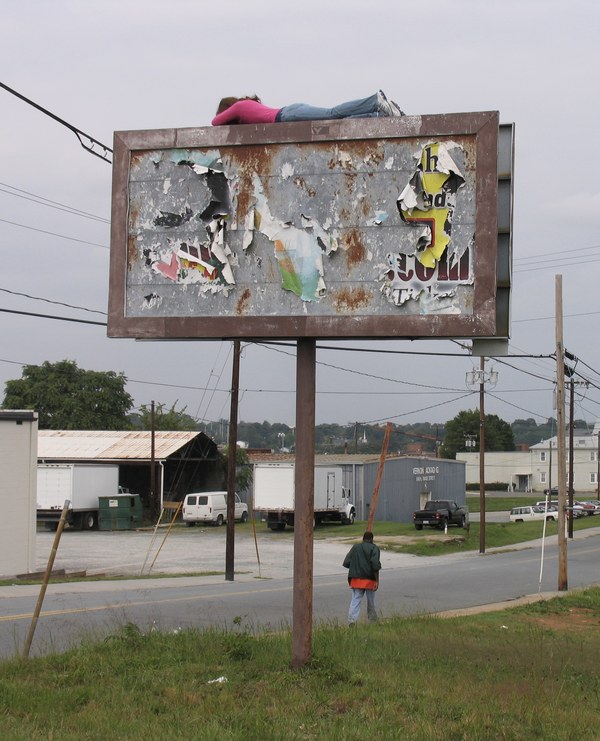
The first figure, Billboard Sleeper, a sculpture of a woman sleeping face down, was installed on top of a tattered unused billboard facing vehicles on Martin Luther King Jr. Dr.
Reaction
Within an hour after we had left, firefighters arrived with a news team and removed the figure. The local newspaper ran a piece. CNN also carried the footage on 23 September 2009.
Installation 2: Chrysalis
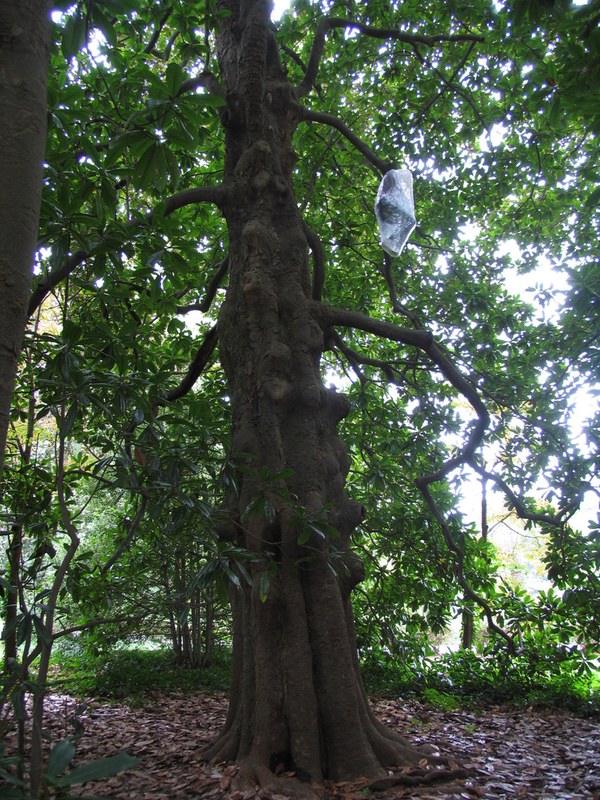
The second piece, Chrysalis, a sculpture of a woman in a clear shell, was installed on the Reynolda House grounds hanging from a branch of a tall magnolia, inside its dense evergreen leaves.
Reaction
The Chrysalis was removed that night, after museum hours, by an emergency unit. The grounds were closed and not illuminated.
Installation 3: Sleepwalker
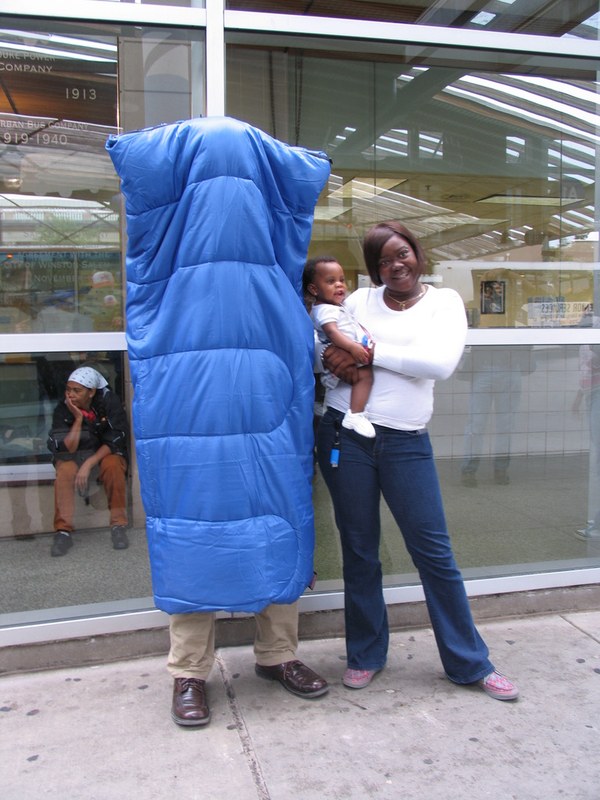
The Sleepwalker, a standing figure in a blue sleeping bag at the Clark Campbell Transportation Center, 100 West Fifth Street, was installed as a dry run to show the city the proposed location.
Reaction
The city granted the permit but the police who were contacted said it would be removed. This led to another story in the local paper.
Installation 4: Bed Girl
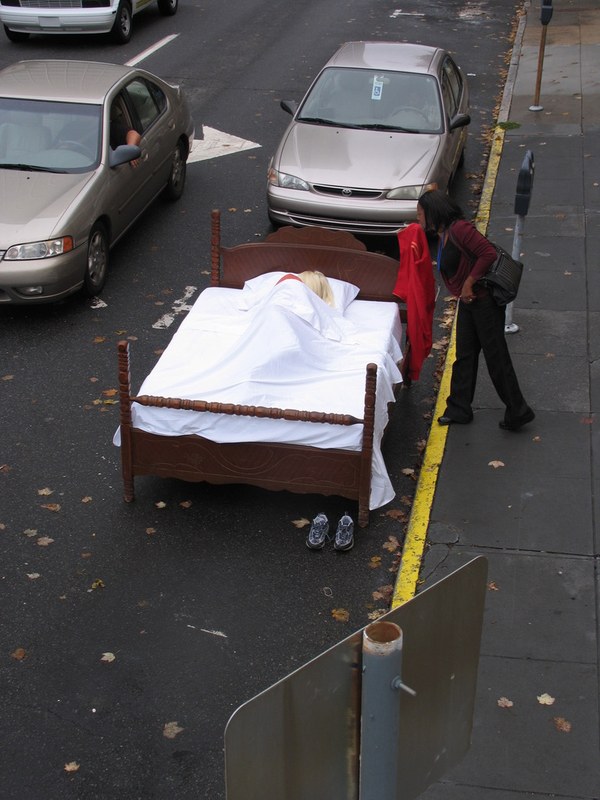
Bed Girl, a sculpture of a girl in a bed, was set up at Fourth and Liberty, at the Pepper Building, to photograph in order to receive a permit.
Reaction
The police rejected it on grounds that it would break the flow of traffic.
Lens
The first virus, Billboard Sleeper, was meant to act as an opsonin on debris: a mark that would make the abandoned billboard readable as waste. An emergency response unit was dispatched instead—likely from a call by a passing vehicle or pedestrian. SECCA had not obtained the owner’s consent and had not warned police or fire. The unit treated the figure itself as the antigen, not the board. The mark was purged. The debris stayed. The nervous system in turn broadcast that a “corpse draped across the billboard,” portraying SECCA as irresponsible. CNN uplifted the story to national news.
The second virus, Chrysalis, could only be experienced by entering its immediate space. The figure was not illuminated, the grounds were closed, and any after-hours observer would have been trespassing. SECCA’s PR contacted the local nervous system (the Winston-Salem Journal), which published an article with SECCA now accusing the immune system of acting as an autoimmune disease -- nourishment classified instead as a pathogen and purged.
The third installation, The Sleepwalker, an absurdist visual anomaly, was issued a city permit, and SECCA contacted police so that it would not be purged. Despite the brain giving permission, the police overruled, citing that it would impede flow and public order. A city permit—an administrative permission to occupy a public space—can be ignored by the immune system. This led to the nervous system publishing a news piece with SECCA labeling it an autoimmune disorder.
The fourth installation, Bed Girl, a bed occupying a metered parking space, was similarly an absurdist visual anomaly turning the city into a landlord charging rent by the minute. Although not a vehicle, city governments do allow dumpsters to occupy a public street if they obtain a right-of-way or temporary street occupancy permit. Once given, displaying the permit and attaching reflective markers, cones, or tape for nighttime visibility is required. The police overruled, citing that it would impede flow and public order, meaning installing the bed would have led to fines and towing. SECCA didn’t do this and instead kept the bed and used it in a later indoor exhibition.
Conclusion
Had SECCA obtained permission from the owner and alerted the police, the conflict could have been avoided. What followed instead was a month-long standoff amplified by the media. The police dug in because they could. The project exposed the body battling itself at the expense of the community whose tax dollars in part funded it. This might seem like a loss for the work. For the museum it was not. A regional museum without a deep collection lives on grants, city money, board confidence, and attendance. Press, especially national press, is what they use as proof of relevance. The feud worked in their favor, moreover, because the community rallied behind the museum. The lecture I gave at the Reynolda as part of the residency was a full house of art lovers who felt wronged by the city, and who were perhaps even enjoying the soap opera themselves, many of them perhaps witnesses to SECCA’s earlier controversy over the award for Serrano’s Piss Christ, which gained the national spotlight.
For myself it was a net disappointment simply because the unused works became property of SECCA. They have no permanent collection, and to my knowledge the pieces never went out. I was told Bed Girl went into a later indoor group exhibition as if a consolation, but in fact it was just absurd irony, and why working with another institution compromises the practice. Doing the installations as a vigilante is optimal, but simply too expensive.
Glossary
The full list of terms is on the glossary page. Words used in this study:
Virus. A camouflaged figure introduced into public space.
Plaque. Advertising deposit on the vessel wall. Here, an unused billboard left tattered.
Nutrition. Visual stimulus that is not an ad.
Immune system. Police and rescue. Clotting when a unit is dispatched.
Nervous system. Media. Local television, then CNN.
Brain. City government. The office that can issue a permit.
Cells. People in the vein.
Opsonin. A mark that flags debris for clearance.
Antigen. What the immune system locks onto. Here, the figure rather than the board.
Reynolda House. The Reynolds family estate, later an American art museum. The lecture for the residency was given there.