The Death of Death / Project 84
Dublin, Ireland 2011 / London, England 2018
Background
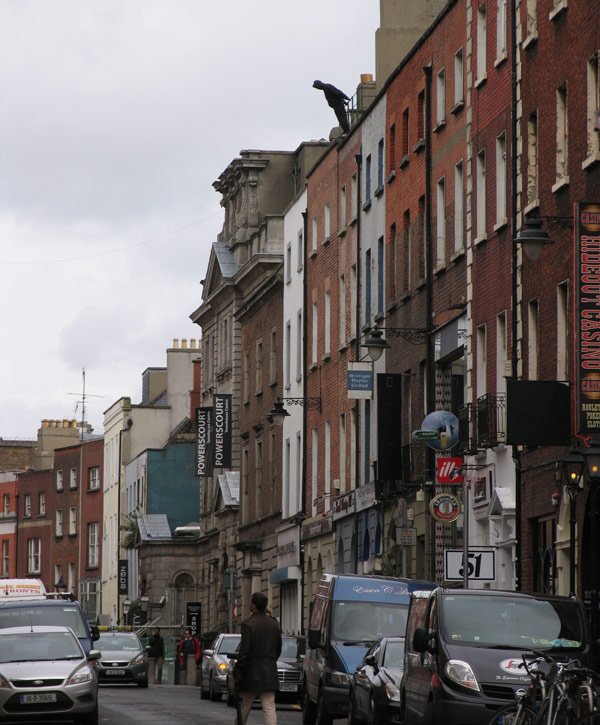
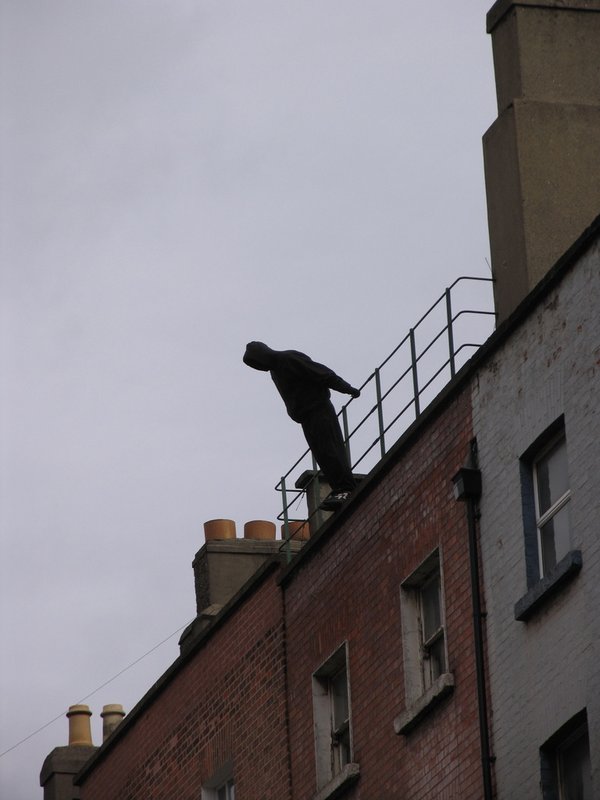
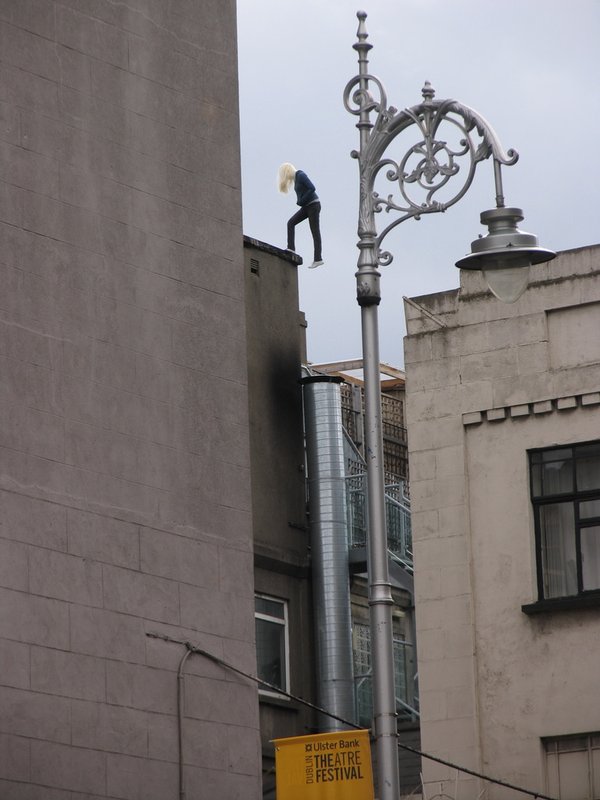
This case study combines two separate installations. The first, The Death of Death (2011), took place in Dublin, Ireland. I was invited to create a series of works for Dublin Contemporary and given a ledge I decided on a conceptual piece of Death committing suicide utilizing an empty hooded character. Another installation accompanied it: Second Chance, which depicted a girl stepping back onto a ledge.
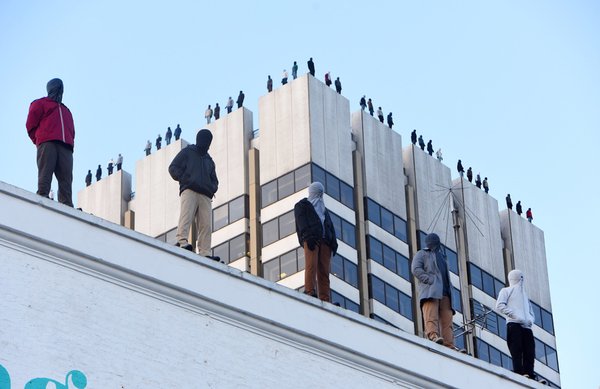
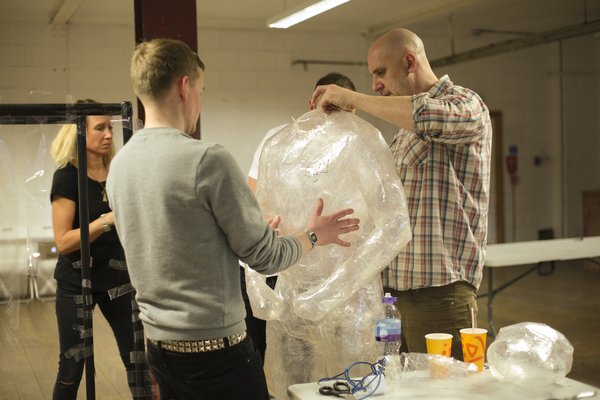
The second project was Project 84 in London (2018). Strong & Co—an organization I previously worked with for Shangri-La at Glastonbury—approached me to create a suicide-awareness project for their client, CALM (Campaign Against Living Miserably). The goal was to highlight that 84 men a week commit suicide by installing 84 figures across London and for me to create 12 of these with family members who had lost someone to suicide. Other partners included the agency adam&eveDDB, sponsor Harry’s, and ITV This Morning, which provided and used the ITV building roof at the South Bank.
Dublin Installation
The Death of Death was installed on a ledge above the shop line on Powerscourt, off South William Street, a brick street in Dublin. The hooded figure was pitched forward over the rail.
Second Chance was installed at 3 South Great George’s Street on a rooftop. The figure had a metal plate and steel armature up through the foot and into the midsection to safeguard it from breaking apart in high winds.
Dublin Reaction
After approximately two months a fire truck removed Death of Death by ladder. Second Chance remained up for a year until it was too weathered and we deinstalled it. It was later reclothed and sold to a collector.
London Installation
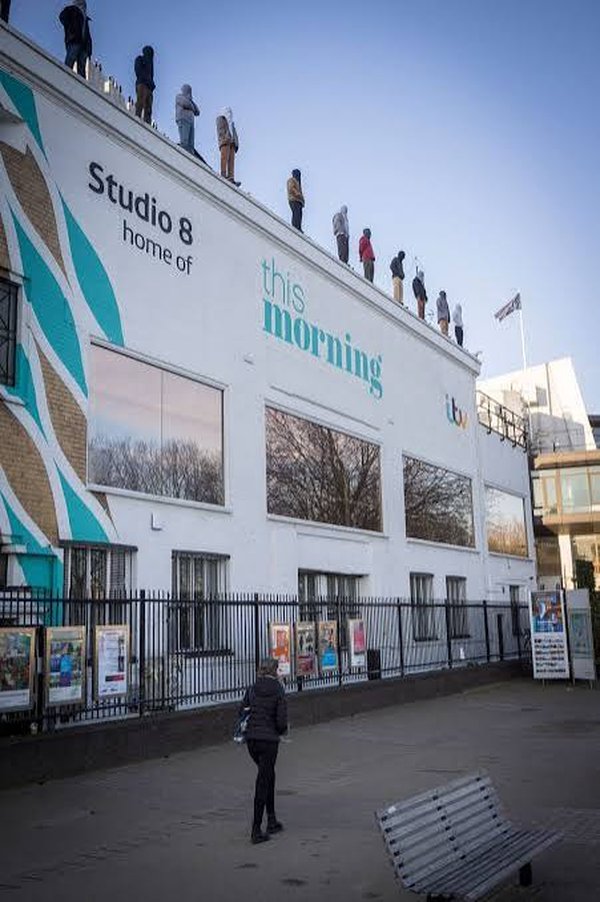
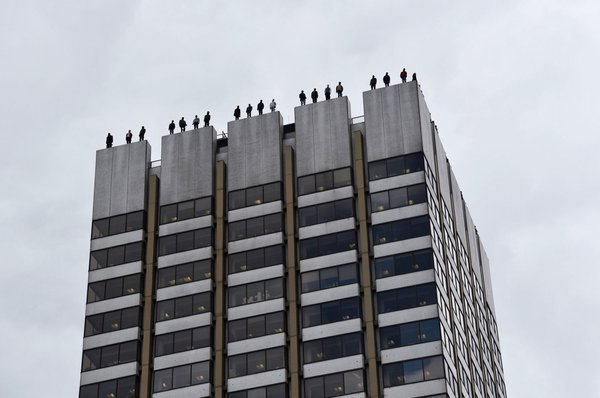
The 12 casts made with the families were installed on top of Studio 8, the This Morning building at ITV on the South Bank above the riverside walkway. The remaining 72 figures—which were dressed mannequins—were installed on the old ITV tower. Because the tower pieces had to withstand strong winds, they were fitted to a steel frame, with poles and scaffolding tying each figure to the roof. These figures were visible from the riverside walkway and, as the highest point in that part of London, from nearly everywhere else. The installation was up for one week.
London Reaction
Volunteers along the river handed out literature to passersby explaining the project and clarifying that the pieces were sculptural effigies. On the beach below, a sand sculptor made a replica of a figure, which drew more attention to the installation.
According to CALM’s own account, earned coverage reached 2.1 billion impressions in seven days, and the petition gained more than 220,000 signatures. The charity later supplied helpline statistics: a 34% rise in some write-ups, and in the D&AD case study, a March rise of 41% year-on-year (an extra 3,666 men), with conversation analysis estimating that at least 239 men were kept alive who otherwise might not have been. The government subsequently appointed the UK’s first Minister for Suicide Prevention, which the campaign claimed as its direct result.
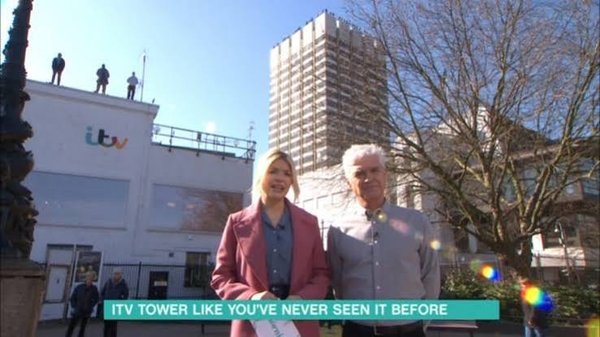
ITV covered the installation extensively, flying drones near the ITV buildings and turning it into a major news piece for London at large. Hosts Holly and Phillip "unveiled" the statues in the studio. Phillip Schofield’s line, carried in The Independent, was: “Here at This Morning we never shy away from stories that can be difficult to talk about.” ITV valued the airtime it gave the campaign at £1,536,618 net, and The Drum’s case study (filed on ITV's behalf) put the petition at 400,000 and the helpline rise at 34%.
Public reaction split between engagement and backlash, with CNN reporting a largely positive response praising stigma-breaking while The Sun and social media captured anxiety over insensitive placement and fears of overwhelming emergency services. That criticism soon escalated into expert concern when Izzy Smith, writing in Cherwell, argued the installation depicted a suicide method linked to contagion—echoing warnings from the Bristol Suicide and Self-Harm Research Group that rooftop figures make jumping cognitively available and prompting Australia’s Mindframe to restrict sharing the imagery.
The ad agency, adam&eveDDB, entered the Project 84 into D&AD, picking up a multitude of awards that helped make adam&eveDDB the second most awarded ad agency in the world that year, alongside a Gold Lion at Cannes (Health & Wellness PR) and a Gold Pencil at The One Show (Creative Effectiveness). In 2020, the agency submitted an IPA Effectiveness paper claiming a societal payback of £5,119 per £1 spent.
Press:
Wooster Collective
Creative Review
CNN
The Drum
Campaign, Project 84
Campaign, Agency of the Year
D&AD
CALM
Wikipedia
Lens
The Death of Death was an activated virus that, if police had not been notified, would likely have led to an immune clotting response to remove and repair. Instead, this happened two months later, for reasons unknown.
Project 84 was unique in that the viral replication was not me but effigies created by participating families who had lost people to suicide. The virus was an effigy intended for the nervous system to carry the message to the rest of the cellular tissue, including the brain. It was also unique that the installation took place on the spinal cord itself: the nervous system installed the work on its own spine, then reported that installation as news.
Because the nervous system (ITV) was a commercial partner, the news coverage declaring the project a success was fundamentally contaminated. Social media reactions remained mixed.
Conclusion
The move from The Death of Death to Project 84 felt initially like an excellent opportunity to further raise awareness about suicide, but overall it had major deficits:
First, the fact that the project was only about male suicide was a miss for me. Suicide awareness shouldn't marginalize women. CALM has since made its support unisex.
Second, the press treated all 84 figures as authentic sculptures when only 12 were true casts (the other 72 being mannequins). Lying is just never a good thing.
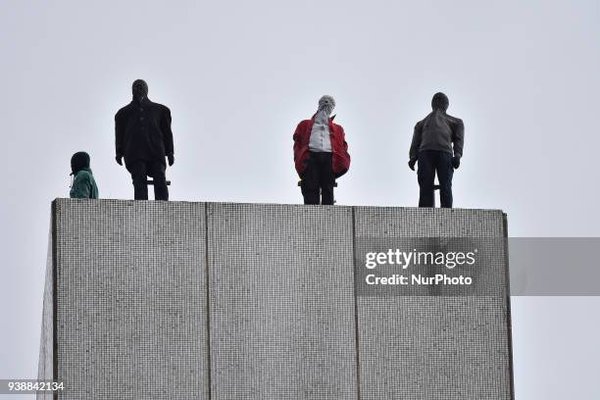
Third, ITV praising itself—unveiling the figures on its own roof and declaring that the show does not shy away from hard topics—reads poorly, and stating the monetary equivalent of its own airtime felt self-serving. It's tacky at best.
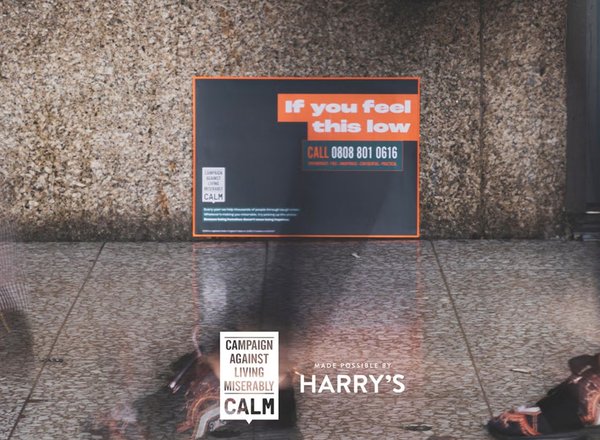 Harry’s, with CALM. South Bank.
Fourth, the degree to which adam&eveDDB went after the awards was unsettling. An award here is a prize from other advertising people. A jury votes, and the agency gets a statue and a line it can show the next client. D&AD, Cannes, the One Show, the IPA effectiveness awards, Campaign’s agency of the year. Agencies take on a charity, do the work for free or cheaply, then enter it. A subject people already grieve is easier to enter, if a number can be attached. Eighty-four dead men a week was that kind of number. adam&eveDDB are not the only ones who do this. They win more of those prizes than most, and they kept CALM as a client for years after. The families sat in the room. The prizes went to the agency.
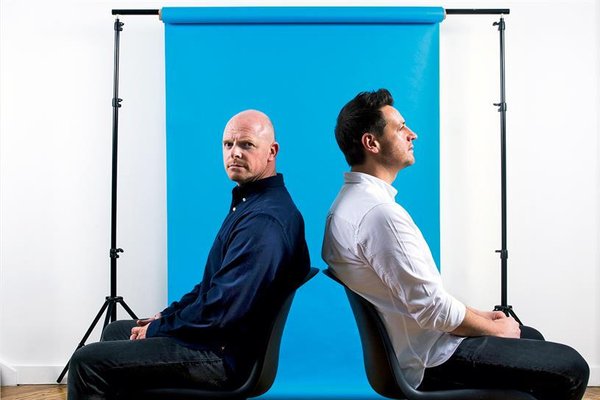 Ant Nelson, left, and Mike Sutherland. Campaign, December 2018.
The core concept credit belongs to the project manager. The installation was based on my existing body of work, including The Death of Death. I had specifically asked to stay out of the press release, wanting to keep focus on the issue. I made the 12 figures, but I did not own the rollout. The only figure I truly claim is the one in Dublin; London is the spin-off, recorded here so its narrative isn't the only one left standing.
The project's major achievement—increasing the petition drive to create a Minister for Mental Health, Inequalities and Suicide Prevention—did happen. It was short-lived. The standalone title of "Suicide Prevention Minister" was effectively dissolved as a distinct, dedicated role in 2021; the entire campaign, including the Project 84 petition, did not result in a new, independent department or a permanent, standalone cabinet seat. Instead, the government took the suicide prevention responsibilities demanded by the petition and tacked them onto the pre-existing workload of a junior health minister (the Parliamentary Under-Secretary), and over the years, as portfolios shifted, it simply became a line item in an under-secretary's crowded brief.
When you strip away the billions of impressions, the self-congratulatory TV segments, and the armful of shiny agency trophies, what you're left with is a textbook case of corporate co-optation. They took a vital, deeply human issue, wrapped it in manufactured artifice, lied about the work to make the visual impact bigger, and then tried to police who could talk the moment it stepped outside their safe, domestic PR box. I built the actual core of the installation out of respect for the families and the gravity of the subject, but the rollout ended up being treated entirely as a brand asset and a vehicle for agency metrics.