Signs of Spring
Washington, DC, February 2008 / Los Angeles 2025
Background
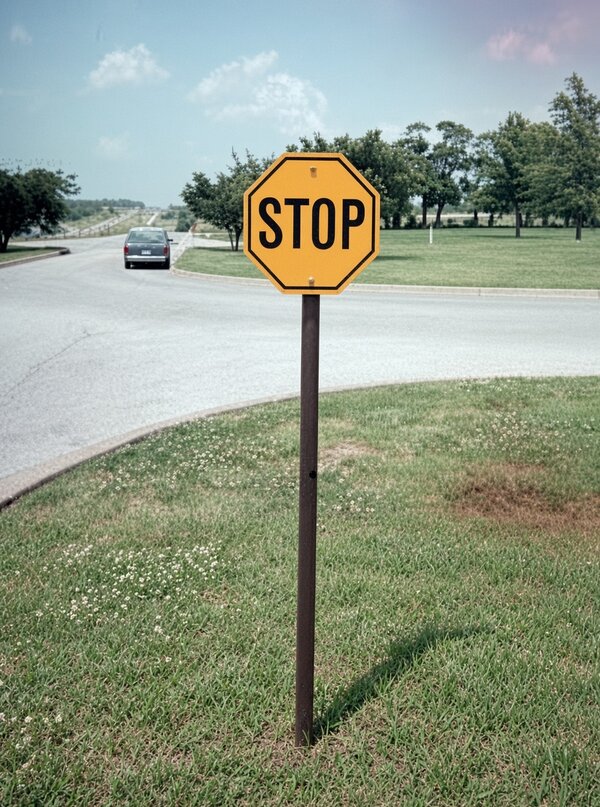
The stop sign actually started out yellow. Until the mid-1950s a red pigment was not durable enough for the street. The symbol rooted itself in the octagon, which made it unique among other signs. The shape stayed recognizable even from the reverse face, so other vehicles could read right of way.
In 1968 it became the international stop face.
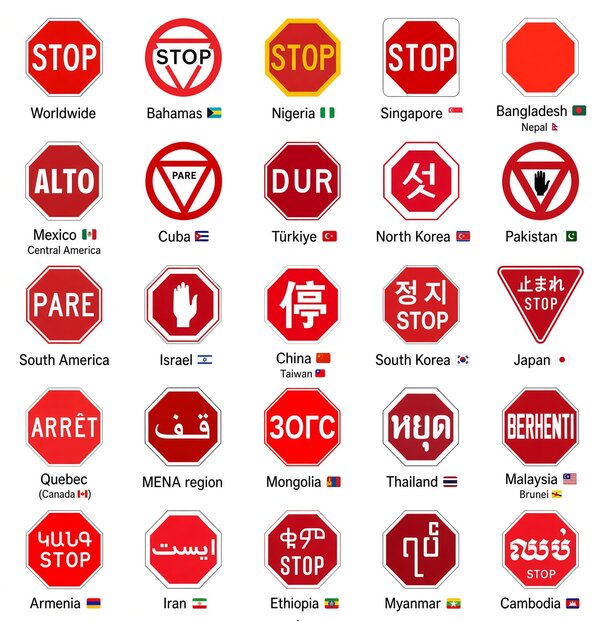
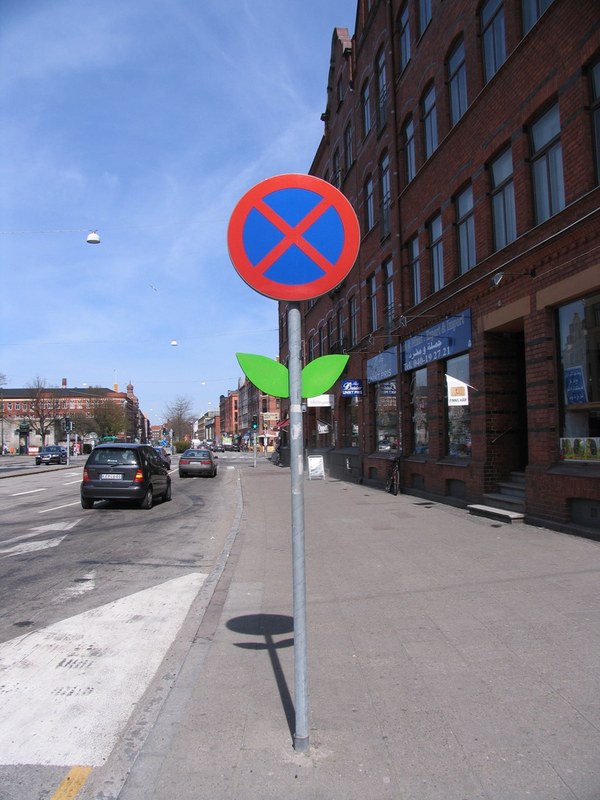
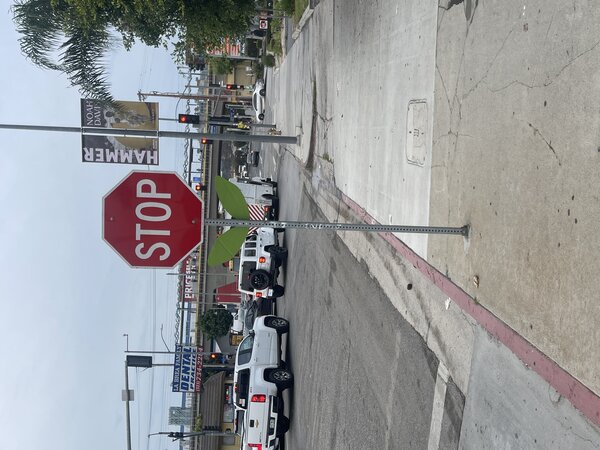
In 2008 I decided to modify it further by adding green petals to turn the red octagon into a flower. The idea was multifold. The command is still there, but it feels polite. Flowers are pleasantly polite. It is debatable if text needs to be there at all. In Western European countries signage is done primarily with symbols.
Installation
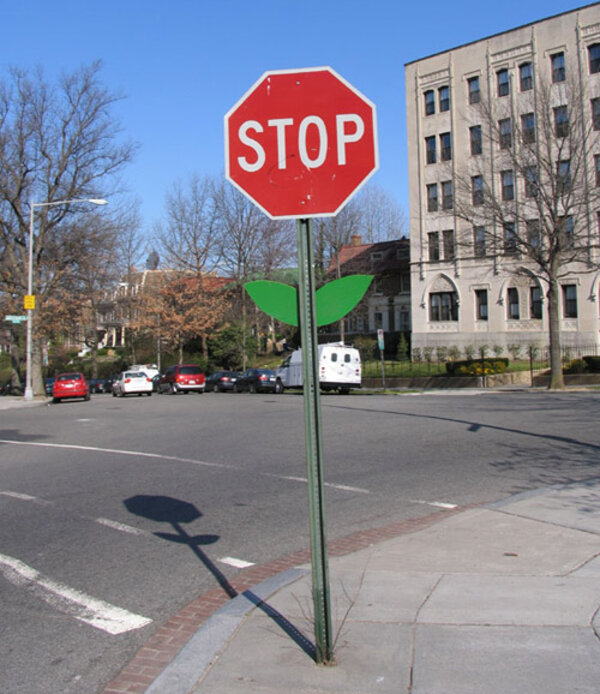
2008
The first run was in Washington, D.C., in the spring of 2008. Petals and leaves were cut from painted cardboard and taped to the face of the octagon. After the first rain the cardboard lost its structure.
2025
In L.A., when I was having a second wind, I upgraded the petals to plywood, painted with house paint, and bolted to the sign. Removal became a tool job rather than a matter of weather.
Reaction
2008
The signs fell apart quickly. It was the photograph that traveled. The project went viral after Boing Boing picked it up.
Press:
Wooster Collective
Trend Hunter
2025
In 2025 the most interesting thing was their staying power. Most street projects are ephemeral and removed by the city within a week or two. Of about twenty of these, most have been up over a year. They would be simple for the city government to remove. They haven't been vandalized. A few have been tagged or stickered, which is common for the signs as well. The city has accepted them.
Lens
Los Angeles has 52,000 stop signs. Each of those signs is working innervation. Each one already has the job of stopping a cell to prevent a collision. Octagon, red, STOP. Necessary. Critical. The tone is what turns that job into herding: stop, look both ways at ads, then proceed.
The petals do not interfere with the sign. They frame the octagon and make the sign more apparent. Medication’s success is measured by what the body did not do. The body did not reject what it ordinarily should. The law exists. The brain chose not to enforce it. The visual aesthetic supersedes “art.” It lets the signage transcend aesthetically. Humans like flowers. Receiving or looking at blooms can trigger immediate happiness, reduce stress hormones, and encourage social bonding. Here the octagon is a visual characteristic of the bloom, and the color red with green triggers a food signal of a habitable landscape.
That said, the brain’s self-imposed rules make it impossible to self-adapt even as a temporary public-art project. Legal adoption would require the highway agency that owns the road to ask the Federal Highway Administration for permission to experiment, and FHWA would have to approve that request before installation. A citizen cannot file the request. Even if the experiment were successful, sanctioning the alteration would likely open the other problem: people treating the signs as boards for garage-sale posters.
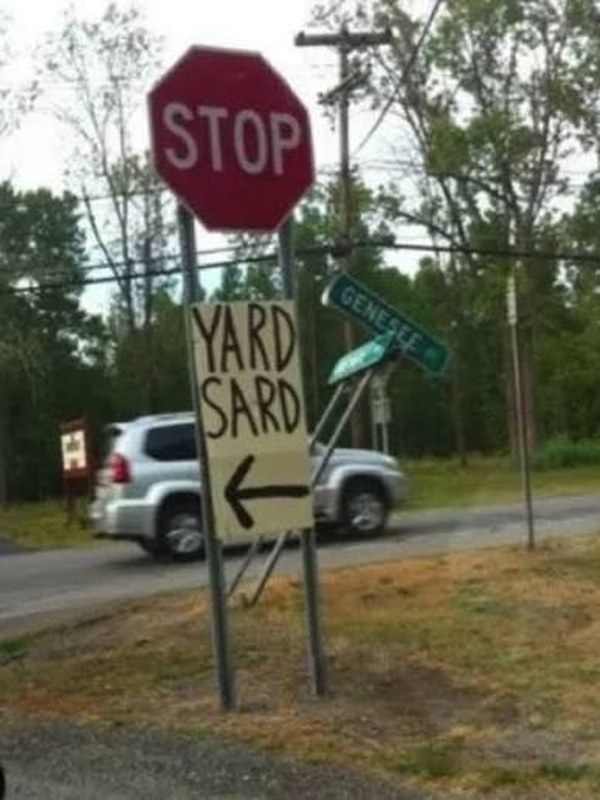 There is no legal route in the United States, and most likely not in other countries, to modify it. The innervation modification has to be done by a vigilante cell. The graft will succeed, and the brain will likely accept it, if the Los Angeles experiment data holds.
Conclusion
This is perhaps the most successful medication, and the least possible to get FDA approval for, metaphorically. It requires, and will most likely always require, breaking the law. It will most likely also be the case that the law will not be enforced — or if it is, a judge will give the minimum sentence and the press will give the project a positive spin, as in 2008.
Cost per sign is about a dollar and about five minutes. To scout city to city doing the repetitive task would become mundane. Cost, legal risk, and time would add up. I don’t really know why I did them in 2008 and paused for seventeen years. Perhaps because they feel as relevant today as they did then, if not more so. I wonder how a Waymo processes it. Perhaps the next modification would be the scent: stop and smell the roses.
Glossary
Medication. A change to official infrastructure that leaves the object in use. The sign still stops the cell. The petals change the tone of the command.
Hacking. Taking a repeating civic object and altering it so it is seen again. The octagon remains an octagon.
Innervation. Official signage: commands fixed to the vein wall.
Vigilante cell. A blood cell that acts on the vein without a permit from the brain.
Nervous system. Media. In 2008 the photograph moved through Boing Boing. In 2025 the feed is Instagram.
Brain. City government and the highway agency that owns the face.
Humor. The sugar in the syrup. The first reading is a flower. The command is still there.
Civil disobedience. Breaking the attachment rule in order to show that the job still holds.
Experiment. The only legal adoption path: the owner of the road asks FHWA for permission to test a non-compliant device.