Traffic-Go-Round
Washington, DC, February 2007
Background
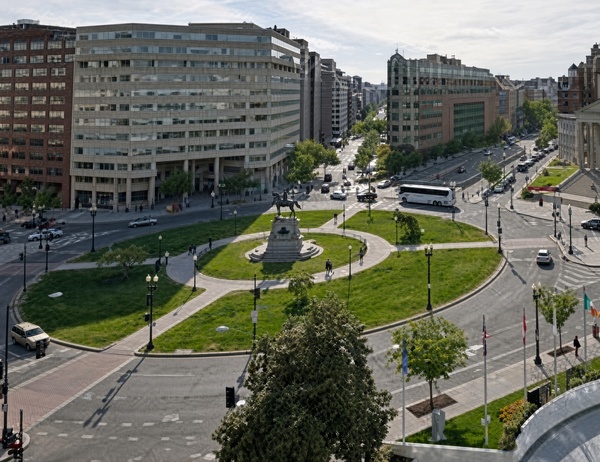
Washington, DC is a peculiar city in that it has an abundance of bronze statues of men on horses, second only to Paris, most of them military monuments. Five of those statues sit in traffic circles.
In October 2006 the District finished a two-and-a-half-year reconstruction of Thomas Circle. The restoration returned the monument of General Thomas, a war hero of the American Civil War, and his horse to public view for a price tag of six million dollars. For thirty-five dollars out of pocket I decided to one-up it into a merry-go-round.
Installation
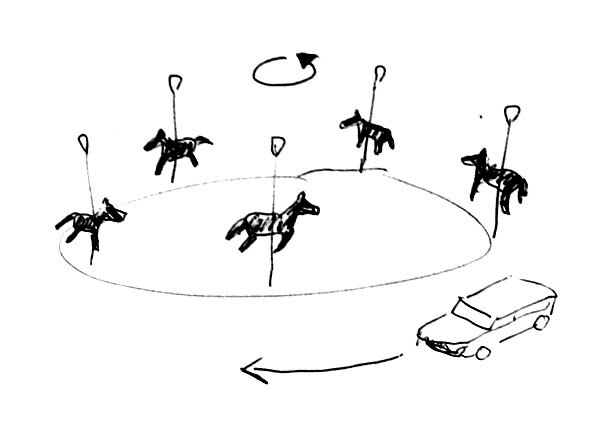
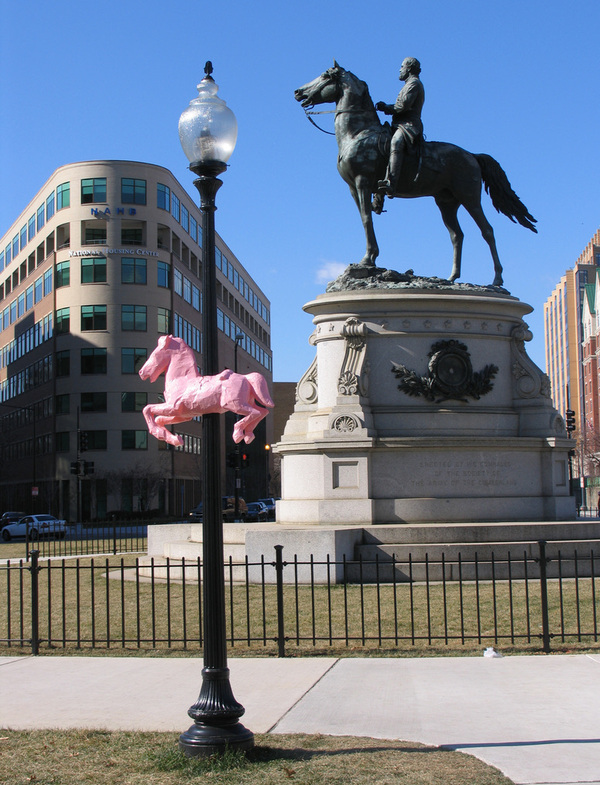
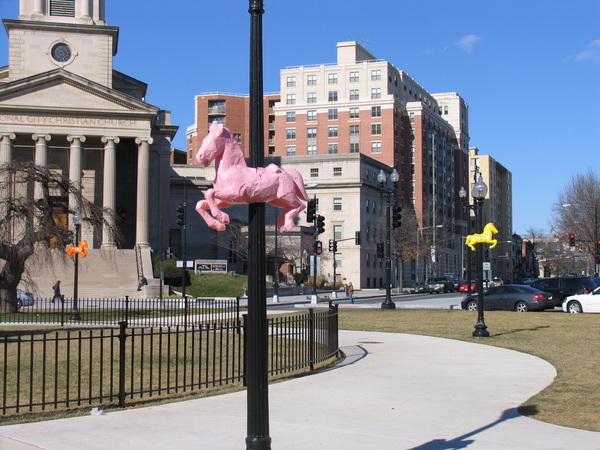
I made five tape casts of a "spring-rider" horse and painted them. These were mounted on lampposts out of arm’s reach, facing clockwise. Cars move in the circle moves counterclockwise would create the illusion of the inner circle spinning like a merry-go-round.
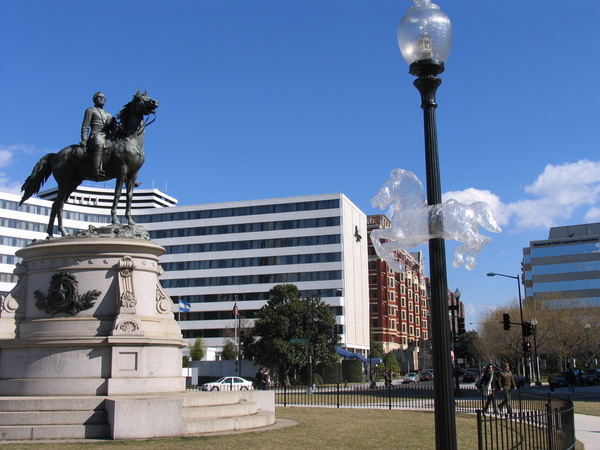
Reaction
The work remained up for approximately three days. Local press covered the piece.
Lens
The work is medication in that it turned the lamp infrastructure into posts for the horses and made a collective merry-go-round.
The carousel horses indirectly stained the General Thomas bronze. A bronze war memorial is not the same thing as ads that try to monetize or trash, but it is visual debris: a moral standard planted in the present that glorifies war. The six-million-dollar restoration of the circle to honor General Thomas is money that could have gone into the vein itself. The carousel proposed another use of the same infrastructure. Press carried that proposal through the nervous system. The brain simply classified the carousel horses as debris for removal.
Conclusion
The installation succeeded: turning a traffic circle into an optical illusion of a spinning merry-go-round that asks nothing more than that one enjoy the ride is worthwhile. Illuminating the war-memorial bronze was a secondary effect. What followed showed the brain’s intolerance of that challenge. In another city the work might have stayed longer. That DC’s city planners prefer the six-million-dollar solution, which restores attention to the memorial, shows a broken system.
Glossary
Medication. A change to official infrastructure that leaves the object in use. The circle still moved traffic. The horses changed what the circuit meant.
Nutrition. Public work that asks nothing in return and sells nothing. The ride was visual. It sold nothing.
Hacking. Taking a repeating civic object and altering it so it is seen again. A traffic circle that becomes a merry-go-round is still a traffic circle.
Humor. The sugar in the syrup. The first reading is a laugh. The rest of the structure follows.
Nervous system. Media. Local press carried the piece from the circle to other cells and to the brain.
Brain. City government. Here, the District that spent six million to restore the bronze and then had the horses taken down.
Vein. The street. Thomas Circle is a node in that conduit. Cars already moved counterclockwise. The horses used that motion.
Stain. Marking what is already sitting in the space so it can be seen. The horses did not take the bronze down. They made the monument, and the bill for restoring it, visible.